Understanding the Difference Between High Street and Digital Banks in the UK
Moving to the UK is an adventure, but let’s be honest, getting your finances sorted can feel like trying to solve a Rubik's Cube blindfolded. One of the biggest hurdles many new arrivals face is simply figuring out where to put their hard-earned cash. This comprehensive guide will walk you through the distinct worlds of high street and digital banking in the UK, helping you understand their differences, benefits, and drawbacks so you can make an informed choice that truly fits your expat life.
The Traditional High Street Banks: A Familiar, Yet Often Frustrating, Landscape
When you first think of banking, images of grand buildings with familiar names like Lloyds, Barclays, HSBC, and NatWest probably spring to mind. These are the behemoths of the UK financial sector, the so-called "high street banks." They've been around for centuries, forming the backbone of the British economy, and offer a sense of physical presence and established trust.
What Defines a High Street Bank?
At their core, high street banks are characterised by their extensive network of physical branches. You can walk into one, speak to a human being face-to-face, and conduct your transactions in person. This can be incredibly reassuring, especially when you're navigating a new country and its unique financial systems. Many expats, particularly those from cultures where in-person banking is standard, find comfort in this tangibility.
They typically offer a full suite of services, from current accounts and savings accounts to mortgages, loans, and investment products. Their infrastructure is vast, and their legacy systems are deeply integrated into the UK's financial fabric. For some, the sheer longevity and perceived stability of these institutions make them the automatic choice, representing reliability in a world that can feel incredibly transient.
The Account Opening Hurdle for Expats
Ah, the infamous proof of address. This is where many expats discover their first major headache with high street banks. To open an account, you're usually required to provide a list of documents, often including proof of identity (passport, visa) and, critically, proof of your UK address. This proof typically needs to be an official document like a utility bill, council tax bill, or a tenancy agreement from a registered letting agency.
The catch? You often can't get these bills without a bank account, creating a maddening Catch-22 situation. You need a bank account to get a utility bill, but you need a utility bill to open a bank account! It's enough to make you want to pull your hair out. I remember spending weeks just trying to get a water bill in my name when I first arrived, just so I could open a proper current account. Banks like HSBC or Barclays might have dedicated expat services or international accounts, but even these can require significant paperwork and a lengthy process. This is a common pain point that our fellow expats often share, leaving them feeling stranded at the very beginning of their financial journey.
The Rise of Digital Challengers: Modern Solutions for a Mobile World
In stark contrast to the traditional high street giants, a new breed of banks has emerged over the last decade: the digital, or "challenger," banks. These institutions, such as Monzo, Starling Bank, and Revolut, operate almost exclusively online or through smartphone apps, eschewing physical branches entirely.
What Makes a Digital Bank Different?
Digital banks are built for the 21st century, designed with a mobile-first philosophy. This means their services are primarily accessed through sleek, intuitive smartphone apps that allow you to manage your money, make payments, and track your spending with just a few taps. They often boast features like instant spending notifications, budgeting tools, and easy categorisation of transactions, which can be incredibly useful for keeping tabs on your finances, especially when you’re figuring out the cost of living in the UK for expats.
Their operational model, free from the overheads of physical branches, often translates to lower fees or even fee-free basic accounts. This leaner structure also allows them to be more agile and innovative, frequently rolling out new features and integrating with other financial tools at a much faster pace than their traditional counterparts. They are, in essence, the nimble startups disrupting the established order.
Simplified Onboarding for New Arrivals
One of the most compelling advantages for expats, and a point of immense relief for many, is the streamlined account opening process offered by digital banks. Forget the endless paperwork and the elusive proof of address. Many digital banks allow you to open an account in minutes, often just needing a photo of your ID (like a passport or national ID card) and a quick video selfie to verify your identity.
This ease of access makes them an absolute lifesaver for new arrivals who haven't yet secured all the traditional documentation required by high street banks. You can often get a working UK bank account and a debit card within days of landing, providing immediate financial independence. This speed and simplicity are a game-changer, removing a significant layer of stress from the already overwhelming process of moving abroad.
Core Banking Services: A Comparative Look
While both types of banks ultimately help you manage your money, the way they deliver these services and the scope of what they offer can differ significantly. Understanding these distinctions is key to deciding which approach aligns best with your needs.
Everyday Banking and Branch Access
High street banks, with their extensive branch networks, offer the comfort of face-to-face interaction. You can deposit cash or cheques over the counter, seek advice from a personal banker, or sort out complex issues with a human being. For those who value personal touch or deal frequently with cash transactions, this can be invaluable. Imagine needing to query a direct debit or get a certified document for official purposes – having a physical branch nearby can be a massive relief. However, branch opening hours are often restrictive, and you might find yourself queuing.
Digital banks, by their very nature, don't have physical branches. All transactions and customer service interactions happen through their app, website, or over the phone. This means no queuing, no travel, and often 24/7 access to your account details. While this offers unparalleled convenience, it can feel impersonal if you're used to traditional banking. For cash deposits, digital banks often partner with services like the Post Office or PayPoint, allowing you to deposit cash at local shops. Cheques are typically deposited by taking a photo through the app or mailing them in.
International Transfers and Exchange Rates
This is an area where expats pay particularly close attention. High street banks offer international money transfers, but these can often come with less competitive exchange rates and sometimes hidden fees. If you're regularly sending money home or receiving funds from abroad, these costs can quickly add up. Always scrutinise the exchange rates and any transfer fees before initiating a transaction with a traditional bank.
Digital banks, particularly those designed with international users in mind, often shine here. Many pride themselves on transparent, low-cost international transfers with highly competitive exchange rates, often using the interbank rate or a very small markup. Brands like Wise, for instance, are renowned for making international money transfers straightforward and affordable, and many digital banks integrate similar functionalities directly into their apps. This can save expats a significant amount of money over time, making it easier to manage finances across borders, especially when considering things like how to transfer money into and out of the UK as an expat.
Fees, Overdrafts, and Financial Products
Beyond the basic current account, both types of banks offer a range of products and services, each with its own fee structure and eligibility criteria. Expats need to be particularly savvy when comparing these, as some can be less accessible to newcomers.
Account Maintenance and Overdraft Charges
Most basic current accounts with high street banks are free to maintain, but they might charge for certain services, like international transfers or replacing lost cards rapidly. Overdrafts are widely available but can come with steep interest rates and arrangement fees. Gaining access to an overdraft facility as a new expat can be tricky, as banks typically require a credit history in the UK, which you simply won't have yet. This means you’ll often start with a basic account with no overdraft, slowly building trust with the bank over time.
Digital banks also typically offer free basic accounts. Their business model relies on charging for premium features (like travel insurance, phone insurance, or advanced budgeting tools) or through subscription tiers. Overdrafts are increasingly becoming available with digital banks, but like their high street counterparts, they'll usually require some financial history in the UK before offering one. However, the app-based nature means you get real-time alerts if you're approaching your limit or going into an unauthorised overdraft, which helps you stay on top of your spending.
Savings, Loans, and Investment Opportunities
High street banks offer a full spectrum of financial products: various types of savings accounts (easy access, fixed-term, ISAs), personal loans, mortgages, and investment platforms. While this comprehensive offering is a strength, expats often face barriers to accessing some of these. Mortgages, for example, typically require a significant deposit, a solid UK credit history, and proof of long-term residency. Investment products also come with their own set of eligibility rules and risk assessments.
Digital banks are rapidly expanding their offerings. Many now provide easy-access savings accounts, and some are venturing into loans and even investment products, often with a focus on simplicity and user-friendliness. While they might not yet match the sheer breadth of a high street bank's portfolio, their focus is often on making financial products accessible and understandable through their apps. If you're looking to open an ISA (tax-free savings) in the UK, some digital banks now offer this, but it’s worth noting that the range might be narrower than traditional providers.
Security, Regulation, and Customer Support
When it comes to your money, security is paramount. It’s natural to wonder if digital banks are as safe as their long-established counterparts.
Protecting Your Money
Both high street and digital banks operating in the UK are regulated by the Financial Conduct Authority (FCA) and the Prudential Regulation Authority (PRA). This is a crucial point: if a bank has a UK banking licence, your eligible deposits are protected by the Financial Services Compensation Scheme (FSCS) up to £85,000 per person, per institution. This means that, in the unlikely event the bank goes bust, your money is protected up to that amount. This applies equally to Lloyds as it does to Monzo or Starling.
Security measures include strong encryption, multi-factor authentication, and fraud detection systems. Digital banks often integrate advanced biometric security (fingerprint, facial recognition) directly into their apps. While high street banks also employ robust online security, the newer digital platforms are often built from the ground up with these modern security features ingrained.
Customer Service Experience
High street banks typically offer multiple channels for customer support: in-branch, phone banking, and online chat. The ability to speak to someone in person is a definite plus for complex issues or for those who prefer human interaction. However, phone lines can have long waiting times, and branch availability is limited.
Digital banks rely heavily on in-app chat, email, and phone support. Their customer service teams are often highly responsive, with many reviews praising their quick and efficient resolution of issues. Because their entire operation is digital, their support staff are typically well-versed in technical issues related to the app and online services. While you won't get face-to-face service, the convenience of getting support directly through your phone, often 24/7, can be a huge advantage.
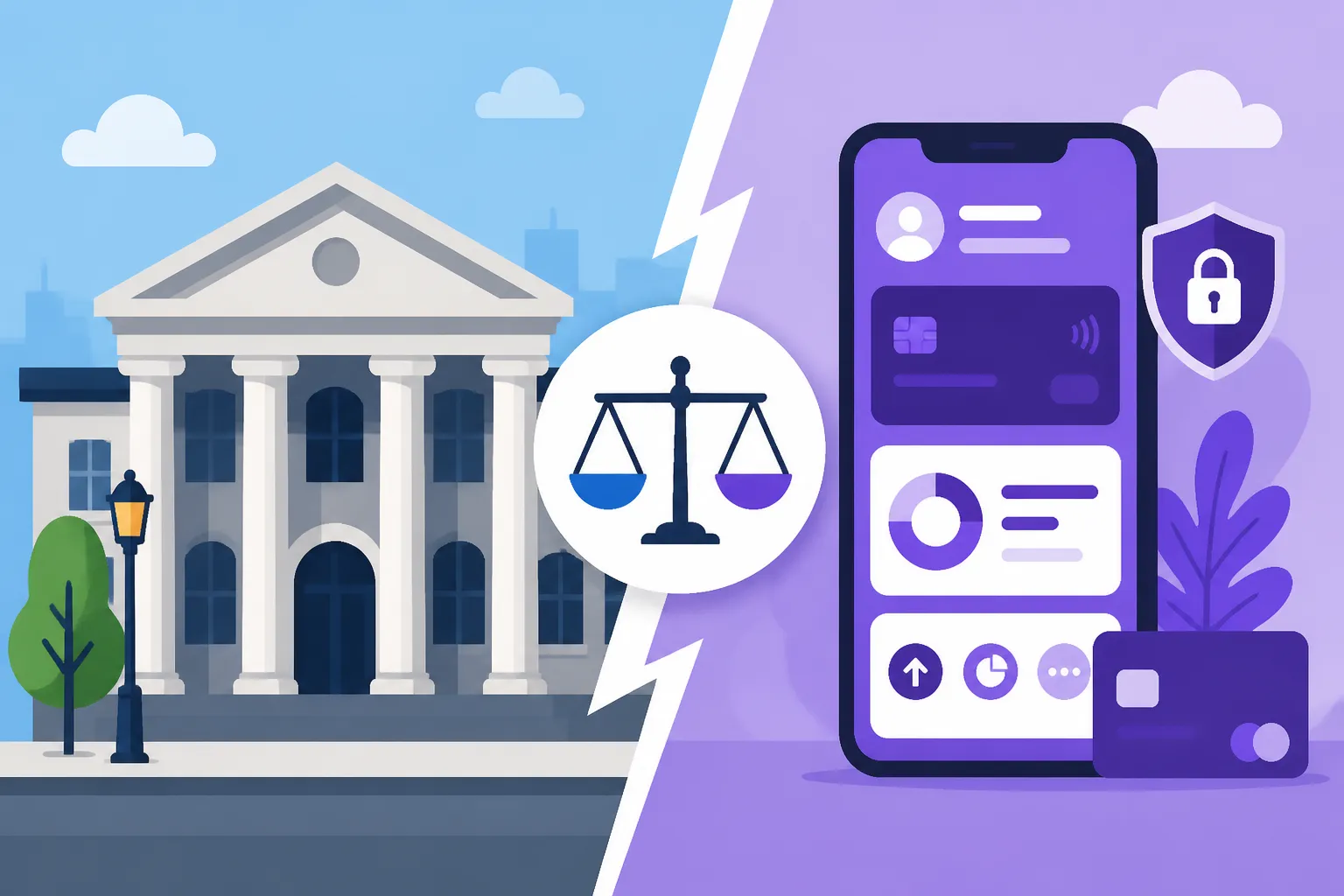
Here's a quick comparison table to summarise some of the key differences:
| Feature/Aspect | High Street Banks (e.g., Lloyds, Barclays) | Digital Banks (e.g., Monzo, Starling) |
|---|---|---|
| Physical Presence | Extensive branch network | No physical branches |
| Account Opening | Often challenging for expats (proof of address) | Usually quick and easy for expats (ID + selfie) |
| Customer Service | In-branch, phone, online chat; varied hours | In-app chat, phone, email; often 24/7 |
| Cash Deposits | In-branch, Post Office | Post Office, PayPoint (via partnerships) |
| International Transfers | Available, but rates/fees can be less competitive | Often competitive rates, transparent fees, fast |
| App Features | Standard online banking, often less intuitive | Feature-rich, intuitive, budgeting tools, instant notifications |
| Product Range | Full suite (mortgages, loans, investments) | Growing range, focused on digital access |
| FSCS Protection | Yes (up to £85,000) | Yes (up to £85,000) |
| Credit Building | Traditional routes, often slower for new expats | Some offer specific tools/products for credit building |
Choosing Your Banking Partner: What's Best for You?
Ultimately, the "best" bank for you as an expat in the UK depends entirely on your individual needs, preferences, and circumstances. There’s no one-size-fits-all answer, and many expats find a hybrid approach works best.
Scenarios Where High Street Banks Shine
If you value the security of a physical presence, prefer face-to-face interactions, or deal frequently with cash or cheques, a high street bank might be a good fit once you’ve managed to jump through the initial hoops. If you're planning to stay in the UK long-term and anticipate needing a mortgage, complex investment products, or extensive financial advice, establishing a relationship with a high street bank could be beneficial. They offer a comprehensive financial ecosystem that digital banks are still building out. For instance, if you're looking into something like how to get a mortgage to buy a home in the UK, a traditional bank might offer more bespoke advice and products suited to complex applications.
You might find that after a few months, once you have utility bills and a bit of credit history, it becomes easier to open an account with a high street bank. Many expats eventually open both: a digital bank for everyday spending and quick international transfers (perhaps using a service like Wise for favourable exchange rates), and a traditional bank for larger financial goals.
When Digital Banks Are Your Best Friend
For new arrivals, digital banks like Monzo or Starling are often an absolute godsend. Their easy account opening process, immediate access to a UK bank account, and user-friendly apps make them perfect for getting set up quickly and managing your daily finances. If you're tech-savvy, travel frequently, or regularly send money internationally, the features and competitive rates of digital banks are incredibly appealing. They provide a fantastic entry point into the UK financial system, giving you breathing room while you sort out other administrative tasks.
They can also be particularly helpful for managing your budget. The instant notifications and spending categorisation can give you a clearer picture of where your money is going, which is invaluable when adapting to a new currency and understanding the true cost of living. When you're thinking about your overall financial picture, including things like your tax obligations, remember that tools and services like "Taxes for Expats" can help you navigate the complexities of your income and residency status.
A Hybrid Approach: Getting the Best of Both Worlds
Many savvy expats choose not to put all their eggs in one basket. They start with a digital bank for the sheer ease of getting established. This allows them to receive their salary, pay local bills, and manage everyday spending. Once they have a UK address history and some financial footprint, they might then open an account with a high street bank for more long-term needs, such as a mortgage, specific savings products, or face-to-face financial planning.
For example, you might use your Starling account for day-to-day spending and quick payments, leveraging its excellent app and fee-free international spending. Then, you might open a current account with Barclays for when you need to deposit a large cheque, discuss a loan, or simply want the assurance of walking into a branch. This dual strategy provides both immediate convenience and long-term security, tailoring your banking setup to the evolving needs of your expat journey. Knowing how to set up online and mobile banking in the UK with either type of institution will be crucial for seamless financial management.
Beyond Basic Accounts: Other Considerations for Expats
Navigating the UK banking landscape involves more than just choosing between high street and digital banks. There are several other elements that expats need to consider to manage their finances effectively.
Building Your UK Credit History
This is a silent struggle for many expats. Without a UK credit history, you’ll find it difficult to get a loan, a credit card, or even some mobile phone contracts. High street banks can be quite rigid here, but some digital banks are starting to offer innovative ways to help you build credit, like credit builder cards or tools that report your rental payments to credit agencies. Consistently paying your bills on time (even utility bills, once you get them sorted) is crucial. Don't forget that getting a National Insurance Number in the UK is also a fundamental step for your financial and employment life here, and it indirectly contributes to your identity verification for financial institutions.
Establishing a financial footprint takes time. Begin with a basic current account, ensure your rent and any bills are paid on time, and consider a 'guaranteed' credit card if available, specifically designed for those with no credit history. Over time, as you prove your reliability, more financial products will become accessible.
Understanding Tax Implications
As an expat, your tax situation in the UK can be complex, especially if you have income or assets in other countries. It’s not just about what you earn here, but also about your residency status and how your worldwide income is treated. Both high street and digital banks will report certain financial information to HMRC, so it's vital that you understand your obligations. Services like "Taxes for Expats" specialise in helping foreign nationals navigate these intricacies, ensuring you’re compliant and making the most of any double taxation agreements.
When you're earning money and opening accounts, it's a good time to get acquainted with concepts like Understanding the UK Tax System (HMRC) Works: PAYE and National Insurance Explained (2026). This will give you a clearer picture of deductions from your salary and how your savings or investment income might be taxed.
Planning for the Future
Whether you're planning to stay in the UK for a few years or indefinitely, thinking about your long-term financial goals is important. This might include saving for a house, retirement, or your children's education. High street banks generally offer a wider array of specialised savings and investment products, including ISAs and pensions. However, digital platforms are catching up, often providing accessible and transparent options for saving and investing directly through their apps.
For example, if you're thinking about investing, some digital banks now offer simplified investment platforms that allow you to invest small amounts regularly. For more complex planning, particularly regarding pensions or larger investments, you might find the expertise of a high street bank’s financial advisor more suitable. Remember, regardless of your choice, understanding how to get an NHS Number in the UK and managing your finances effectively are intertwined aspects of establishing a stable life here.
Disclaimer
Please remember that I am an expat lifestyle blogger, not a financial advisor. The information provided in this guide is for general informational purposes only and does not constitute financial, legal, or tax advice. Banking products, fees, and regulations can change, so it is essential to conduct your own research, check the most up-to-date terms directly with financial institutions, and consider seeking professional advice tailored to your personal circumstances before making any financial decisions. While I strive to provide accurate and helpful information based on my experience and current knowledge, individual situations vary greatly.