Can Foreigners Open a Barclays or HSBC Account in the UK?
Landing in the UK, full of excitement and a list of urgent tasks, you quickly realise that one seemingly simple item—opening a bank account—can morph into a truly baffling administrative nightmare. You’d think a major global bank like Barclays or HSBC would be a welcoming haven for new arrivals, given their international presence. Instead, many foreigners find themselves caught in a frustrating loop. This guide is here to untangle that complexity, explaining exactly what to expect from traditional UK banks and offering realistic alternative solutions for securing your financial footing as an expat or tourist.
The Initial Hurdle: Why Traditional UK Banks Seem Like Fortresses
Oh, the joy of arriving in a new country! You’ve got your visa, your accommodation (maybe temporary), and your new job or study place lined up. The natural next step is to open a bank account so you can actually get paid, pay bills, and generally exist. But for many, especially those who come from countries where opening a bank account is a five-minute affair, the UK’s traditional banking system feels less like a helpful service and more like a medieval castle with an unbreachable moat.
The reality is that UK banks, particularly the big high-street names, operate under extremely strict regulations, primarily driven by anti-money laundering (AML) and 'Know Your Customer' (KYC) requirements. While these are in place for good reason, they create immense friction for anyone who hasn't already established a robust paper trail within the UK. It’s a classic Catch-22: you need a bank account to get proof of address, but you need proof of address to open a bank account. It’s enough to make you want to pull your hair out!
Understanding the "Proof of Address" Conundrum
This is the single biggest stumbling block for almost every newcomer. When a traditional UK bank asks for proof of address, they're not looking for just any old piece of mail. They want official, government-issued or utility company-issued documents that unequivocally link you to a specific residential address in the UK. This often means things like:
- A utility bill (gas, electricity, water, landline phone – not a mobile phone bill, usually) dated within the last three months.
- A council tax bill for the current financial year.
- A bank statement from another UK bank (which you don't have yet, obviously).
- A tenancy agreement from a registered letting agent or landlord, often coupled with a utility bill in your name.
- A letter from HMRC (His Majesty's Revenue and Customs) or DWP (Department for Work and Pensions).
Now, imagine arriving in the UK. You might be staying in temporary accommodation, a hotel, or even with friends. You don't have any utility bills in your name yet because you haven't lived in a place long enough to get them. Your tenancy agreement, if you even have one immediately, might not be considered "official enough" by every bank, or it might be dated too recently. This frustrating loop means that what seems like a simple bureaucratic requirement becomes a Herculean task for many. The very documents that prove you live somewhere are often only generated once you've already started living there and paying bills, a process that requires a bank account!
Standard Account Requirements for Foreigners
Beyond the proof of address, traditional banks like Barclays and HSBC will, of course, require other standard documentation to open an account. These are usually less problematic but still need to be in perfect order. You'll typically need:
- Valid Passport or National ID: This is your primary form of identification, proving who you are and your nationality.
- Proof of your immigration status: This could be your UK visa, your Biometric Residence Permit (BRP), or your eVisa share code. They need to see that you have the legal right to reside in the UK.
- Evidence of employment or studies: An official letter from your UK employer confirming your job offer and start date, or a university acceptance letter and enrolment certificate. This helps establish your purpose for being in the UK and your financial stability.
- Your National Insurance (NI) Number: While not always mandatory for opening an account, many banks will ask for it, especially if you’re employed. It's a critical identifier for taxes and social security in the UK. If you haven't got one yet, don't worry too much about it for the initial bank account opening, but definitely prioritise getting one once you're settled. You can read more about How to Get a National Insurance Number in the UK to streamline this process.
Even with all these documents in hand, the "proof of address" remains the sticky wicket. Banks are ultra-cautious, and if your documents don't fit their exact, often rigid, criteria, you'll be politely (or sometimes not-so-politely) turned away.
Navigating Barclays and HSBC as a Newcomer
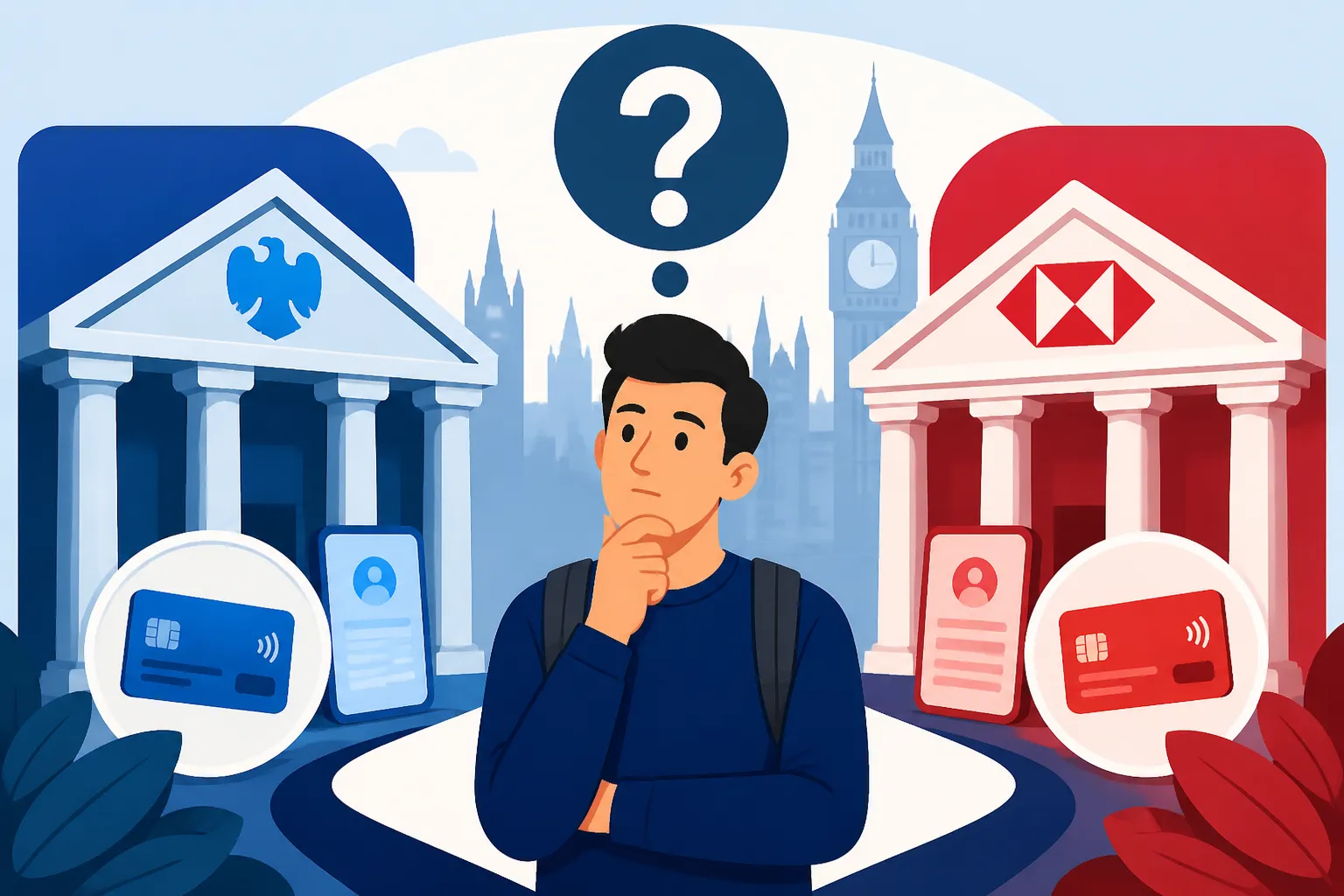
When you think of banking giants, Barclays and HSBC often come to mind. They're established, reputable, and have a global presence, which might lead you to believe they'd be more accommodating to international arrivals. The truth, however, is a mixed bag. While they do have international services, their standard current account opening process for new residents can be just as, if not more, challenging than other high-street banks due to their strict internal policies.
Opening an Account with Barclays
Barclays is a massive institution, and while they cater to millions of customers, their process for new international arrivals can feel a bit like trying to solve a Rubik's Cube blindfolded. For a standard current account, the proof of address requirement is non-negotiable and often rigidly interpreted. They are looking for those official utility bills, council tax statements, or registered tenancy agreements. If you walk into a branch with just a temporary accommodation letter or an employer's letter, you're very likely to hit a wall.
However, Barclays does have options for some international customers. They offer what's called a 'Barclays International Bank Account', but this is generally targeted at those with significant wealth, complex international banking needs, or existing Barclays relationships in other countries. These accounts often come with high minimum deposit requirements or monthly fees, making them unsuitable for the average expat just looking for a basic current account to receive their salary. If you're coming from a country where you already bank with Barclays, it might be worth inquiring if your existing relationship can ease the process, but don't hold your breath for a direct, seamless transfer to a standard UK current account without fulfilling the local requirements.
My advice? If you're set on Barclays, try to get a proper, formal tenancy agreement in place and then ensure you have a utility bill in your name as quickly as possible. Then, make an appointment at a branch, armed with every single piece of documentation you possess.
Opening an Account with HSBC
HSBC, like Barclays, prides itself on its international reach. It's often seen as the bank for expats in many parts of the world. However, this global perspective doesn't necessarily translate to an easier process for opening a standard current account in the UK as a brand-new arrival with no UK credit history or address proof. They too have very stringent KYC requirements.
HSBC offers 'Expat Accounts' and 'Premier Accounts', which are designed for those moving internationally. These can indeed be excellent solutions, but much like Barclays International, they typically come with high eligibility criteria. For example, an HSBC Premier Account might require you to maintain a certain level of savings or investments with them, or have a very high income. If you're a student or someone just starting their first job in the UK, these options are likely out of reach.
For a standard current account, you'll face the same proof of address challenge as with Barclays. While some HSBC branches might be slightly more flexible if you have a solid employer letter or a letter from your university, it’s not guaranteed. You might hear stories from fellow expats who had an easier time, but policies can change, and interpretation can vary from branch to branch or even staff member to staff member.
The key takeaway for both Barclays and HSBC is that while they are global players, their standard UK retail banking divisions operate very much by UK rules, making the initial hurdle of opening an account for a newcomer quite significant. If you're serious about banking with them, your best bet is to secure solid proof of address first. You can get a deeper understanding of the general process by looking at The Expat Guide to Opening a Bank Account in the UK.
Beyond the High Street Giants: Alternative Banking Solutions
Given the formidable challenge of opening an account with traditional high-street banks like Barclays and HSBC as a new arrival, it's no wonder many expats turn to alternative solutions. In today's digital age, there are fantastic options that completely sidestep many of the bureaucratic hoops, making your life infinitely easier.
Challenger Banks and Digital-Only Options
This is where many new expats find their saving grace. Over the last decade, a new breed of banks, often called "challenger banks" or "digital-only banks," have emerged in the UK, built specifically to be more agile, customer-friendly, and accessible. Think names like Monzo, Revolut, and Starling Bank. These aren't just trendy apps; they are fully licensed banks, regulated by the Financial Conduct Authority (FCA) and, importantly, your deposits are protected by the Financial Services Compensation Scheme (FSCS) up to £85,000, just like traditional banks.
Why are they easier for newcomers?
- Less Rigid Proof of Address: This is the big one! While they still need to verify your identity and address, they are often much more flexible with what they accept. A tenancy agreement, a letter from your employer, or even simply providing a valid UK address to which they can send your debit card can sometimes be sufficient. They use advanced digital verification processes that rely less on traditional paper trails.
- Quick Setup: You can typically open an account in minutes directly from your smartphone. You download the app, provide your ID (a quick photo of your passport and a selfie usually does it), and within a day or two, your account is active and your physical card is on its way.
- No Physical Branches (mostly): This is both a pro and a con. While you can't walk into a branch for face-to-face service, their customer support is usually excellent and available 24/7 through the app or phone. Plus, you won't waste time being turned away at a counter.
- Great Features: These banks are designed for modern life. They offer instant notifications, budgeting tools, easy splitting of bills, and often competitive exchange rates for international transactions. For example, for sending money abroad, platforms like Wise integrate seamlessly with these accounts, offering transparent and low-cost international transfers, making managing your money across borders much simpler than with traditional banks.
Many expats start with a digital bank account to get their finances up and running, receive their first salary, and then later, once they have utility bills and other proofs of address, they might consider opening an account with a traditional bank if they feel the need. But for many, the digital-only option becomes their primary bank. To understand the different options better, refer to How to Open a Bank Account at a UK Bank as a Newcomer.
Here’s a quick comparison of traditional vs. digital banks for new arrivals:
| Feature | Traditional Banks (e.g., Barclays, HSBC) | Digital Banks (e.g., Monzo, Starling, Revolut) |
|---|---|---|
| Account Opening Speed | Can take weeks, often requires branch visit and appointment | Minutes to hours via app |
| Proof of Address | Very strict (utility bills, council tax, formal tenancy) | More flexible (tenancy, employer letter, address for card delivery) |
| International Focus | Dedicated international accounts (often high threshold); standard accounts less so | Designed for international use, often competitive exchange rates |
| Physical Branches | Yes, widespread | No (mostly app-based) |
| Customer Service | Branch, phone, online (can be slow) | 24/7 in-app chat, phone (usually fast) |
| FSCS Protection | Yes, up to £85,000 | Yes, up to £85,000 (for UK-licensed banks like Monzo/Starling) |
| Initial Experience | Often frustrating, bureaucratic | Smooth, user-friendly |
Leveraging Your Existing International Bank
Another avenue, though less common, is to see if your current bank in your home country has a UK branch or a partnership with a UK bank. Some large global banks might be able to facilitate a smoother transfer or account opening process if you're an existing, trusted customer.
For example, if you bank with a large international institution like Citibank or Deutsche Bank in your home country, inquire about their services for expats moving to the UK. They might have a dedicated international desk that can help you open a basic account or at least provide an easier path than starting from scratch with a completely new bank. However, even in these scenarios, you'll still often face some form of the UK's stringent documentation requirements, but perhaps with a little more understanding from your existing banking relationship manager.
This isn't a guaranteed solution, but it’s worth a phone call to your home bank before you move, especially if you have a strong, long-standing relationship with them.
Other "Starter" Proofs of Address
While digital banks offer a great way around the strict proof of address requirements, it's still useful to know what other documents might be accepted by some institutions or for certain situations. When you're trying to get that initial bank account, every bit of official mail counts.
- Employer's Letter: A formal letter from your UK employer confirming your employment, your UK address, and your start date. Some banks, particularly smaller ones or credit unions, might accept this as a temporary proof, but it's not universally accepted by the big high-street names.
- Tenancy Agreement: A legally binding tenancy agreement for your UK residence. This is often a strong piece of evidence, especially if it's from a reputable letting agency. However, some banks may still want to see a utility bill in your name alongside it to fully verify that you've moved in and are responsible for bills at that address.
- National Insurance Number Letter: Once you apply for and receive your National Insurance number, HMRC will send you an official letter. This letter is gold! It's issued by a government body and contains your name and UK address, making it an excellent piece of proof of address for many financial institutions. If you haven't received yours yet, understanding How to Get a National Insurance Number in the UK is a vital step.
- Student Enrolment Letter: For international students, an official letter from your UK university confirming your enrolment and your UK term-time address can sometimes be sufficient for certain student-friendly bank accounts.
The key is to gather as many official documents as possible, even if you think they're secondary. The more evidence you can present of your legitimate presence at a UK address, the better your chances, especially when dealing with the traditional banks.
Practical Tips for a Smoother Account Opening Process
Moving to a new country like the UK involves a mountain of paperwork and processes. When it comes to banking, a little preparation and persistence can go a long way in making the experience less stressful.
Get Your Documents in Order (and Then Some)
This cannot be stressed enough: be meticulously organised. When a bank asks for documentation, they mean all of it, in its original form, and often with photocopies. Don't assume anything. Have everything prepared and readily accessible.
Here's your essential checklist:
- Your valid passport or national ID card: The original and several photocopies.
- Your visa or Biometric Residence Permit (BRP) / eVisa share code: The physical card/document and copies, or the share code for online verification.
- Proof of address: As discussed, this is the trickiest. Have your tenancy agreement (signed and dated), any utility bills (even if they're for a previous tenant but show the address), an employer's letter with your address, a university enrolment letter, or any official correspondence from HMRC or DWP (like your National Insurance number confirmation letter). The more, the merrier.
- Proof of employment/student status: Your employment contract, a letter from your employer on company letterhead confirming your job title, start date, and salary. For students, your university acceptance letter and proof of enrolment.
- Recent bank statements from your home country: While not always required, these can sometimes help demonstrate your financial history and stability, especially if you have an existing relationship with an international bank.
Remember, the bank staff are following procedures. The clearer and more complete your documentation, the smoother the process will be. For a comprehensive list of what you might need, check out What Documents Do I Need to Open a Bank Account in the UK?.
Start Early and Be Persistent
Opening a bank account in the UK is rarely an overnight affair for foreigners. It’s not like signing up for Netflix. This is particularly true if you're aiming for a traditional bank. The proof of address issue alone means it could take weeks or even months after you arrive to gather the necessary documents.
- Start researching before you arrive: Understand the requirements and the options available.
- Don't wait: As soon as you have a stable UK address and any form of official documentation tied to it, start the process.
- Be prepared for rejection: It's disheartening, but it happens. Don't take it personally. If one branch or one bank says no, try another, or explore the digital alternatives. Many expats will tell you it's a bit of a "rite of passage" to experience the initial bank account frustration!
- Make appointments: For traditional banks, walking in rarely works. Book an appointment online or by phone. This ensures you speak to someone specifically dedicated to new accounts.
Consider Your Banking Needs
Before you dive in, take a moment to consider what you actually need from your bank account. Your requirements as a student might be different from those of a working professional or someone looking to buy property.
- Daily spending and salary: Most current accounts will cover this.
- International transfers: If you're regularly sending money back home or receiving funds from abroad, look for banks or services that offer competitive exchange rates and low fees. This is where services like Wise really shine, as they are specifically designed for efficient international money transfers, often at a fraction of the cost of traditional banks. You can link your digital or traditional UK bank account to a Wise account for seamless transfers.
- Savings: Do you need a separate savings account? Many banks offer easy-access or fixed-term savings options.
- Future plans: Are you planning to stay long-term? Will you need a mortgage one day? Building a relationship with a traditional bank might be beneficial for future lending, but often your credit history starts fresh in the UK anyway.
- Business or self-employment: If you're self-employed, you'll need to think about a separate business account. And don't forget the tax implications! Engaging with experts like Taxes for Expats can help you navigate the complexities of managing income and accounts, ensuring you're compliant with HMRC. This will also feed into your understanding of The Complete Guide to Taxes in the UK for Expats (2027).
The key is to be pragmatic. Don't let the pursuit of a traditional high-street bank account delay your financial integration into the UK. A digital bank account can be an excellent first step, providing you with a functional account while you gather the necessary documentation for more traditional options, if you still want them down the line. Setting up utilities, for instance, requires a stable address, and eventually, having a UK bank account makes paying those bills much easier. Find out more about The Expat Guide to Setting Up Utilities (Energy, Water, Broadband) in the UK.
Frequently Asked Questions by Foreigners About UK Banking
It's completely normal to have a ton of questions when you're navigating the UK banking system as a newcomer. Here are some of the most common ones I hear from fellow expats.
Can I Open an Account Before Arriving in the UK?
Generally speaking, for a standard UK current account, the answer is usually no. Most traditional banks, including Barclays and HSBC, require you to be physically present in the UK to complete the identity verification process. This often involves an in-person visit to a branch, or at the very least, robust online verification that confirms your presence.
Some international banking services, particularly those associated with high-net-worth accounts, might offer pre-arrival account opening, but these are typically not for your everyday banking needs and come with significant deposit requirements. Similarly, while digital banks like Monzo or Starling are incredibly easy to set up, they usually require you to be physically in the UK to activate the account and receive your debit card. They often need you to provide a UK address for the card to be sent to, and sometimes require you to verify your identity by taking a video or photo while present in the UK.
My advice is to plan on opening your main UK bank account after you've landed and have a temporary or permanent address. For immediate financial needs upon arrival, consider bringing some local currency, using an international travel card, or relying on a service like Wise to hold a UK balance that you can access with their debit card.
What If I Don't Have a Permanent Address Yet?
This is the classic expat conundrum, and it’s arguably the biggest hurdle. If you're staying in temporary accommodation (like an Airbnb, hotel, or short-term rental) without a formal tenancy agreement or utility bills in your name, opening an account with traditional banks will be extremely difficult.
Here’s how you can approach it:
- Prioritise finding a permanent address: The sooner you have a tenancy agreement for a long-term rental, the better. This is your golden ticket for traditional banks.
- Employer's Letter: As mentioned, a detailed letter from your UK employer stating your start date, salary, and confirming your UK residential address (even if temporary) might be accepted by some challenger banks or more flexible traditional banks. This needs to be on company letterhead.
- Friend's Address (with caution): If you're staying with a friend or family, they might be able to write a formal letter confirming your residence with them. This usually needs to be accompanied by their utility bill and possibly even them coming to the bank with you. Be aware that not all banks accept this, and it can be a hassle for your friend.
- Digital Banks are Your Best Bet: This is where Monzo, Starling, and Revolut truly shine. Their more flexible approach to address verification is designed for situations just like this. They often allow you to open an account with just a tenancy agreement or sometimes even just a verifiable UK address where your card can be sent. Many expats use a digital bank account as their first financial stepping stone in the UK.
Do I Need a National Insurance Number to Open a Bank Account?
No, you generally do not need a National Insurance (NI) number to open a bank account in the UK. Banks are primarily concerned with verifying your identity and your address, as per their anti-money laundering obligations.
However, once your account is open, many banks will ask for your NI number, especially if you're receiving income like a salary into the account. This is because your NI number is essential for tax purposes and ensuring your income is correctly reported to HMRC. So, while it's not usually a prerequisite for opening the account, it's something you'll definitely need to sort out once you're in the UK, particularly if you're working. You can learn all about it in How the UK Tax System (HMRC) Works: PAYE and National Insurance Explained (2027).
In summary, don't let the lack of an NI number delay your bank account application. Focus on your passport/visa and, most importantly, your proof of address. The NI number can follow.
Disclaimer
Please remember that I am an expat blogger, not a financial advisor or immigration expert. The information provided in this guide is based on my personal experiences, extensive research, and general understanding of the UK banking system for foreigners. Banking regulations and requirements can change frequently, and individual circumstances vary. Always consult the official websites of banks, HMRC, and the UK government for the most current and accurate information. For personalised financial or legal advice, please seek assistance from qualified professionals.